
Direct democracy
Will the citizen-centred National Refoundation Council win over voters sitting on the fence about Macron?

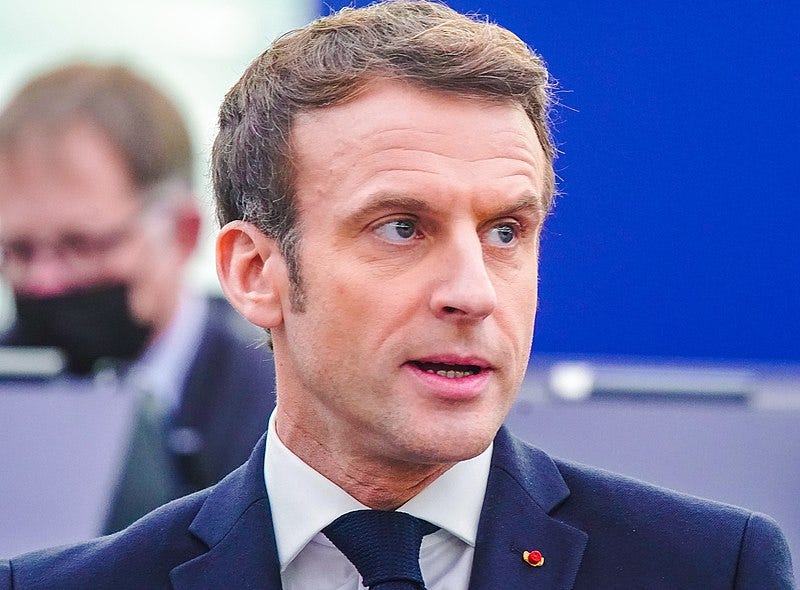
After weeks of anticipation, a shiny new institution will weigh in on French politics over the next few months… or possibly for longer.
Whilst many details remain unclear, news arrived this week that the Conseil national de la refondation (CNR), or National Refoundation Council, will be established on 8 September.
Macron announced it back at the start of June.
It looks like the CNR will be a sort of citizen assembly, uniting figures from the social, political and economic worlds, as well as a handful of randomly selected citizens.
The president hopes the CNR will clarify the debate on five key objectives for his next five-year term, including: industrial, military and food independence; full employment; net zero, equal opportunities via public services; and a democratic renaissance through institutional reforms.
The president has promised discussions on public services, most notably health and schooling.
Macron had a 38% approval rating at the start of August, after a recent low of around 32% in May.
The CNR could be read as an attempt by Macron to restore confidence in politics among voters from whom he is seen to be disconnected, or whose trust he believes he has lost.
That must be one reason why Macron commented to regional press organisations on Friday that "French people are tired of reforms coming from above".
Some in France believe Macron's style of governance has at times been too vertical.
He advocated a "Jupiterian" presidency in a 2016 interview.
And in the run-up to this year's election campaign, Macron's administration was criticised for alleged overuse of the consulting firm McKinsey when it came to making political decisions.
Spending was at a whopping €893 million in 2021 under prime minister Jean Castex.
A report from France's Sénat published in March argued that "the use of consultants is now a reflex" in political decision-making and that this constituted a "dependence".
It also argued that McKinsey had paid little corporation tax in France for 10 years, despite 5% of its operations being in the public sector.
Whilst the Government rejected a "twisted report", it has since promised a consulting spend limit of €2m per project from 2023, and committed to an overall reduction of at least 15%.
Macron also came under pressure in July for assisting Uber as economy minister, after a law had been passed by the then government to regulate taxi services based on apps.
Although some in France and abroad see this kind of lobbying activity as a given, it can spark controversy in France.
Job security and the precariousness of the informal economy can be explosive issues in a country that has seen powerful expressions of discontentment like those of the gilets jaunes in 2018.
Some say Macron is a "president des riches" and allude to his background as an investment banker at Rothschild.
His decision to replace the impôt sur la fortune [Wealth Tax] with the impôt sur la fortune immobilière [Property Wealth Tax] was criticised by some.
According to the left-wing investigations organisation basta!, the IFI generated almost three times less in 2020 than the IFS in 2017.
Nevertheless, in the discussion surrounding whether Macron is a président des riches, his recent cost-of-living reforms constitute just one example of his actions to support the poorest.
And so Macron's CNR plan may be one step towards reducing French voters' concerns.
At face value, it sounds similar to the Grand Débat National held by Macron during a series of public meetings across France in early 2019.
Citizens were asked to "put into words their difficulties, explain their expectations and write down their anger".
The CNR may be a new way for Macron to meet and listen to ordinary people, and improve his communication with them.
It may also be a strategic decision to enable the president to focus on addressing their discontent.
Despite having a low rate of trade unionism, the French are in general known for their striking.
Amidst a cost-of-living crisis, or crise du pouvoir d'achat, a return of the gilets jaunes or similar would no doubt be a political crisis for a president who is already short of a parliamentary majority.
And given parliament won't sit in September, only coming back in October, will this be a post-summer focus?
Many practicalities are, however, yet to be determined.
At the moment, we know there will be several sessions and regular follow-up meetings.
But how will participants be chosen? How will citizens have the loudest voice, and not that of any presidential spin doctors?
And how will it be legitimate amidst a fractured political landscape and high levels of voter abstention, and while parliament is already the country's political forum?
Will the micronarrative replace the metanarrative? The stories await to be told.